Servo pumps need synchronous motors – fact or myth?
Requirements for operating servo pumps
Servo pumps are increasingly being used in modern hydraulic systems – primarily to reduce energy consumption, noise and heat generation. However, there is a widespread myth that persists: many users believe that the use of a servo pump necessarily requires a synchronous motor. Is there any truth to this assumption? And what are the technical requirements for putting a servo pump into operation?

Supporting movements, amplifying forces or enabling precise control processes – there are numerous reasons for plant and machine manufacturers to rely on servo pumps as hydraulic pressure generators. Put simply, a servo pump is a variable-speed pump unit in which the motor is controlled as required by means of a frequency inverter. This enables the servo pump to generate the controlled pressure required for hydraulic drives, cylinders or valves. Unlike normal hydraulic pumps, a servo pump can adjust pressure and volume flow much more quickly, create more precise movement profiles and deliver higher repeat accuracy. This makes the servo pump particularly interesting for applications that require high dynamics and precision. Whereas conventional hydraulic presses run at constant motor speed even when no force is required, the servo pump adjusts the speed and volume flow to the respective process, thereby significantly reducing energy consumption. The advantages are also evident in the field of injection moulding machines: here too, energy costs, noise emissions and cycle times (particularly important in injection moulding) can be reduce
These motors are suitable
When implementing the optimal servo pump solution, users must first answer the question of which drive is suitable. And this is precisely where confusion often arises, as Michael Schulz, application engineer at KEB Automation, knows: "We support customers in various fields in the implementation of servo pump solutions. There is often an assumption that a servo pump requires a synchronous motor – but that is incorrect.‘ Although a servo pump can in principle be operated with a synchronous motor, there is no technical necessity for this. Schulz adds: ’In fact, various motor technologies are suitable – including synchronous reluctance machines or three-phase asynchronous motors with frequency inverters.
The terms ‘servo’ and ‘synchronous’ are frequently used interchangeably. However, the servo concept is not based on the motor design, but on controlled operation. The fact that servo pumps are often combined with servo motors – such as synchronous motors – is historically due to their high dynamics. ‘However, the misunderstanding is also contributed to by the fact that manufacturers often refer to combinations of servo pumps and permanent magnet synchronous motors (PMSM) as “servo solutions”,’ says Schulz. The fact is that modern inverter technology now makes it possible to use different motor designs equally.
In addition to PMSMs, synchronous reluctance motors are also an option. These offer good dynamics thanks to precise current control. Since the motors do not require permanent magnets, the user is also less dependent on materials such as rare earths. Robust and cost-effective, they are an exciting option when it comes to operating servo pumps. The classic asynchronous motor is also suitable when operated via a frequency inverter. Modern vector control units now enable precise servo characteristics to be achieved – while at the same time offering the benefits of proven, robust and cost-effective technology that is sufficiently dynamic for many hydraulic applications.
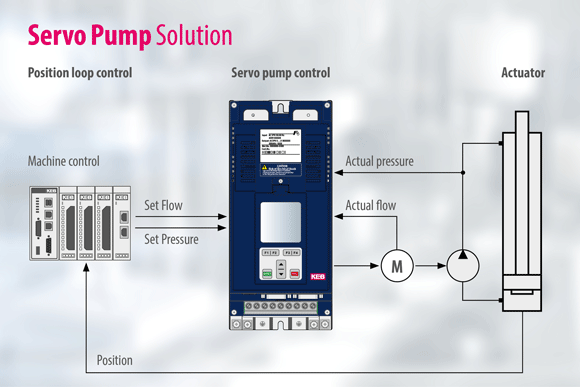
Servo pump solution from KEB
Given that it is now the control technology of the frequency inverter rather than the motor design that is decisive for servo pump operation, KEB has integrated the servo pump control function into the COMBIVERT F6 and S6 drives. "With our drive controllers, all motors can be operated at the highest quality. The integrated software in the drives has an algorithm that can be used to control the flow and pressure of the servo pump. Pump protection is implemented by means of appropriate software features and parameters," says Schulz. A wizard for guided parameterisation of the application and the autotuning function simplify system commissioning. KEB's servo pump control in combination with the right motors can achieve energy savings of up to 70 per cent.
