Why HELIO? 3 questions for ECON
Stefan Schedlik from ECON on the use of the HMI management tool
ECON's underwater pelletising systems are in demand worldwide in the plastics industry. The reason: the company develops energy-efficient solutions with patented thermal insulation technology that allows materials to be pelletised that would otherwise be difficult or impossible to process. ECON relies on KEB for its drive solution. Stefan Schedlik, Technical Director at ECON, explains the role played by KEB's HELIO HMI management tool and HMI Project.

Why did you choose HELIO to visualise your machine data?
Schedlik: We supply customers all over the world with our underwater pelletising systems. Different countries have different customer specifications when it comes to the control systems to be used. If a particular market relies on control systems from manufacturer A, then I also need visualisation from manufacturer A. In another market, the situation is completely different. Under these circumstances, we end up with four or five different visualisations, all of which need to be maintained and further developed. The advantage of HELIO is that I only need a single visualisation that can communicate with all control systems. This saves me the effort of having to create different visualisations, including all the operating instructions and documentation. Without HELIO, I would need additional internal programmers to implement the different HMIs in different programmes, or external service providers. This additional effort is now no longer necessary.
What is important to you in HMI design?
Consistency is important to us in visualisation. It should be recognisable that this is an HMI designed by ECON. We have branches in the USA, China and India. We deliver a standard product there until commissioning. If the customer has special requests on site, our technician adapts the product on site, which means that we have many different HMI designs in operation worldwide. With the introduction of HELIO, we now have a uniform design. In future, programmers will no longer design the visualisation on their own, but there will be a concept, a design that is specified throughout ECON. However, a certain degree of flexibility will remain. So if a programmer wants to add a specific pressure or speed, that is of course possible.
How was the implementation of HELIO in your systems?
A big advantage was that KEB already knew how our machine worked because we were already connected via frequency inverters and motors. We felt and still feel that we are in good hands with KEB and HMI Project, and we received personal support during the implementation of the visualisation. All implementation problems were solved immediately thanks to direct contact persons. With HELIO, I can now dock the control I want and have significantly less work to do. The remote maintenance function via an extra VPN remote maintenance router or a panel is also practical. HELIO is also very easy to use because no programming knowledge is required. In the past, a programmer would provide texts, which were then edited by the technical editorial team and a translation agency. HELIO provides all of this, so that the technical editorial team can take care of creating the HMI independently.
About the collaboration between ECON and KEB
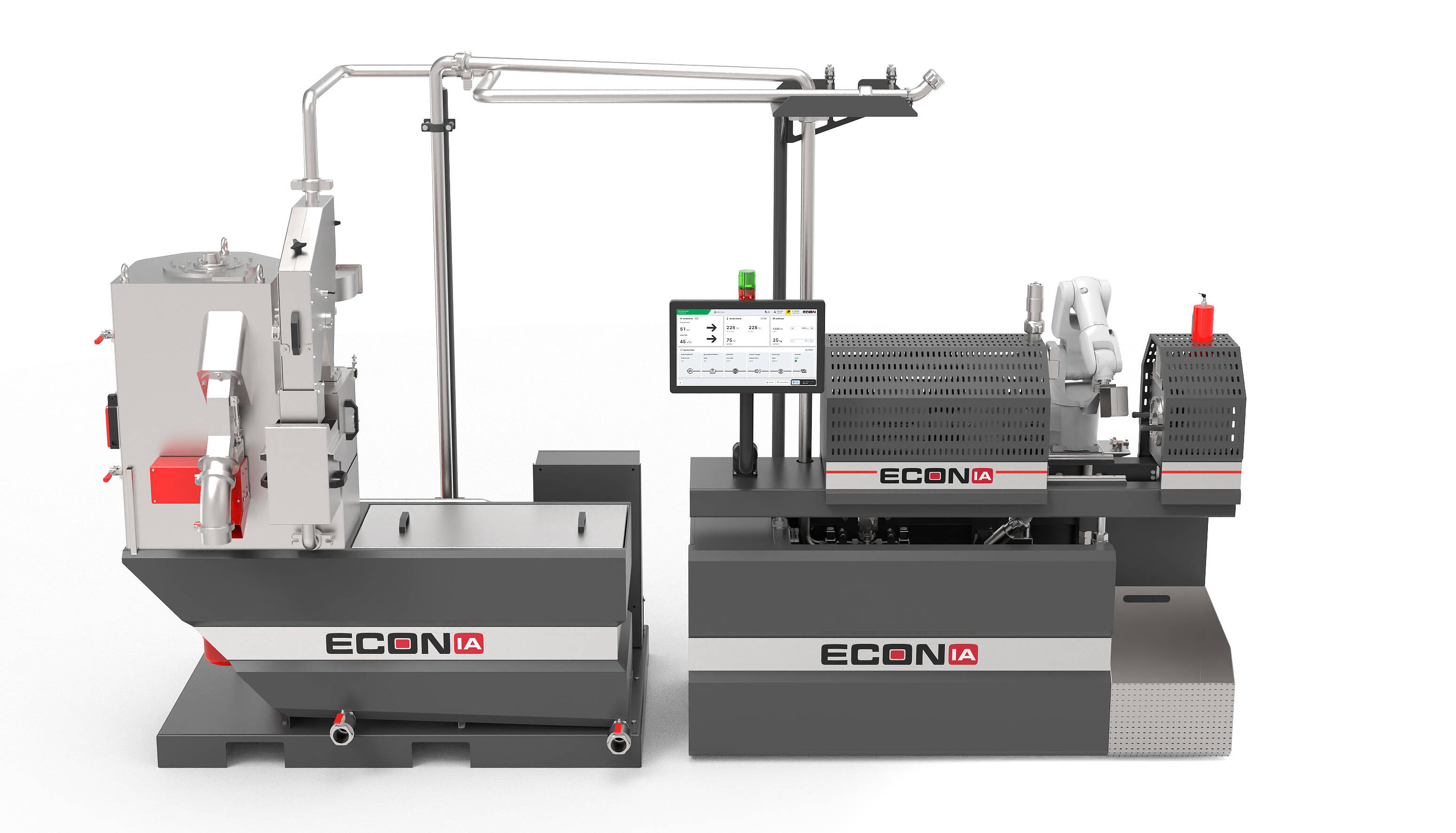
ECON has specialised in underwater pelletising for over 20 years. The Austrian company, based in Weisskirchen, has developed into one of the leading machine manufacturers for the plastics production and processing industry. With ECONia, ECON offers an innovative system for fully automatic underwater pelletising and relies on HELIO. The HMI management tool visualises machine data in a particularly convenient way.
Find out more about the technology behind the ECON application and how HELIO and the machine work together in our blog soon.
