3 special functions to optimise extruders
KEB Drives with integrated screw protection and more for extrusion technology
Extruders are indispensable in the manufacture of moulded plastic products. This makes it all the more important to tailor automation and drive solutions to the specific requirements of extrusion technology. KEB Automation therefore relies on the integration of special functions for plastics processing when implementing high-performance system solutions. The goal: to significantly increase the process reliability and efficiency of extruders.
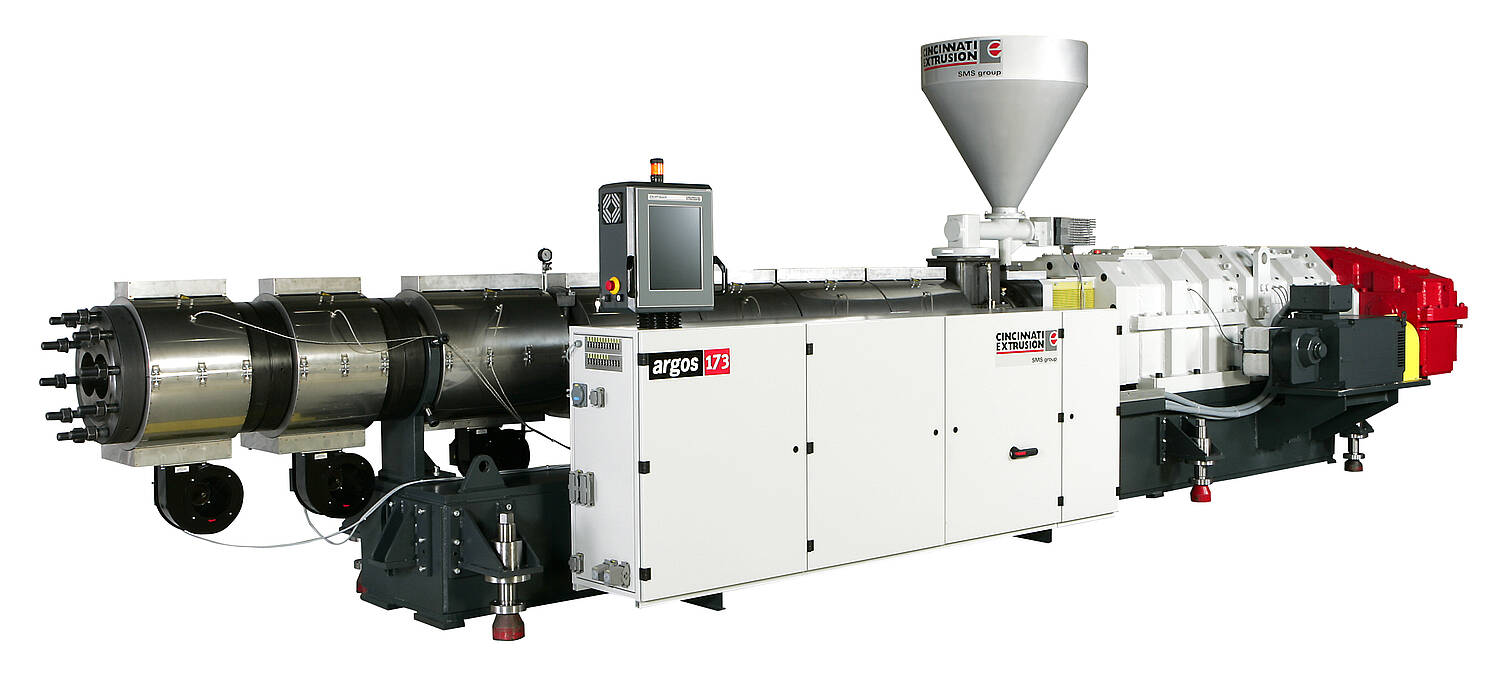
Melting plastics, homogenising them and shaping them into a defined form – the tasks of extruders are diverse. In doing so, they can essentially produce products such as pipes, profiles or cable sheathing continuously and ensure consistent material quality. This is because temperature and pressure can be precisely controlled. The fundamental principle behind extrusion technology is that solid plastic granulate is conveyed through a heated cylinder by a rotating screw and plastified. “In extrusion, a constant flow rate is essential to achieve the highest possible material output. One of the keys to success here is keeping machine downtime to a minimum,” says Tim Aufderheide, sales engineer at KEB Automation.
For extruding the material, drive controllers capable of delivering power up to the megawatt range are required, amongst other things. KEB meets these requirements with the COMBIVERT F6 drives and, where necessary, by connecting up to three units in parallel – a method in which several power sections jointly supply an electric drive system. Beyond drive technology, KEB offers the option of fully automating the extrusion line. From control technology and drive controllers right through to motors. KEB’s 360-degree solution for plastics processing also includes a special highlight: various special functions are integrated into the drives specifically for the operation of extruders, which significantly increase the process reliability and efficiency of the systems.
Screw protection
The screw is at the heart of the extrusion process. This makes the corresponding protection functions integrated into the COMBIVERT F6 drives all the more important. They closely monitor the screw’s condition and help prevent damage. The screw protection function is particularly relevant when molten polymer remains in the screw’s geometry after the extruder has been shut down and cools slowly, for example overnight or over the weekend. As a result, the material crystallises and shrinks, adhering more strongly to the metal, which ultimately leads to inhomogeneous residual zones on the screw. When the screw is restarted, it does not convey a homogeneous material bed, but rather hard residues and cold plugs. This results in increased friction between the screw and the material, and the material that has not yet been fully plasticised behaves like a solid. Due to the higher screw torque, jerky start-up and torque peaks, there is a risk of destroying the screw without appropriate protective functions.
Encoder-free speed and torque control
With their precise speed and torque control, the COMBIVERT F6 and S6 drives feature an integrated function for controlling the screw torque and the speed of synchronous or synchronous reluctance motors without an encoder. The high speed and torque accuracy not only ensures product quality and consistent performance but also protects the mechanical components. “For sensorless motor control, the SCL (Sensorless Closed Loop) and ASCL (Asynchronous Sensorless Closed Loop) control methods developed by KEB are available, enabling the highest accuracy,” says Aufderheide.
These methods allow users to save on the costs of encoders and cables whilst still benefiting from maximum accuracy. With encoderless operation, both the risk of encoder failure and the influence of environmental conditions become less significant. (A)SCL uses standard drive hardware, is selectable via software, and enables flexible configuration of various referencing options to suit the specific application.
E.UP suppression
The error message E.UP indicates an undervoltage in the DC link (Under Voltage Error) on COMBIVERT F6 drive controllers. If the DC link voltage drops below a defined threshold, the drive would shut down immediately without this additional function and trigger the E.UP error. E.UP suppression prevents this immediate shutdown if the voltage dip is only temporary, is due to operational conditions, and the drive can still be safely controlled. This makes the F6 significantly more robust against short-term mains and load fluctuations.
Technically, E.UP suppression continuously monitors the DC link voltage. If it detects a brief dip, the fault is masked or delayed. At the same time, the inverter internally reduces power and torque to continue running stably. Shutdown only occurs in the event of a sustained voltage dip. This is particularly important for extruders: without E.UP suppression, brief voltage dips would lead to an immediate standstill – resulting in process interruption and material loss. With the function activated, the drive continues to run, if necessary with slightly reduced torque, and the process remains stable.
