Electric vs. pneumatic robot grippers
KEB braking solution for end-effectors
As the interface between the robot and the workpiece, grippers play a central role in robotics. Cobots, industrial robots and humanoid robots all use grippers as so-called end-effectors to safely pick up, hold, position and set down products or materials. Essentially, users have two different solutions at their disposal: electric and pneumatic grippers. But which variant is particularly convincing? And what role do KEB Automation’s brakes play in this context?
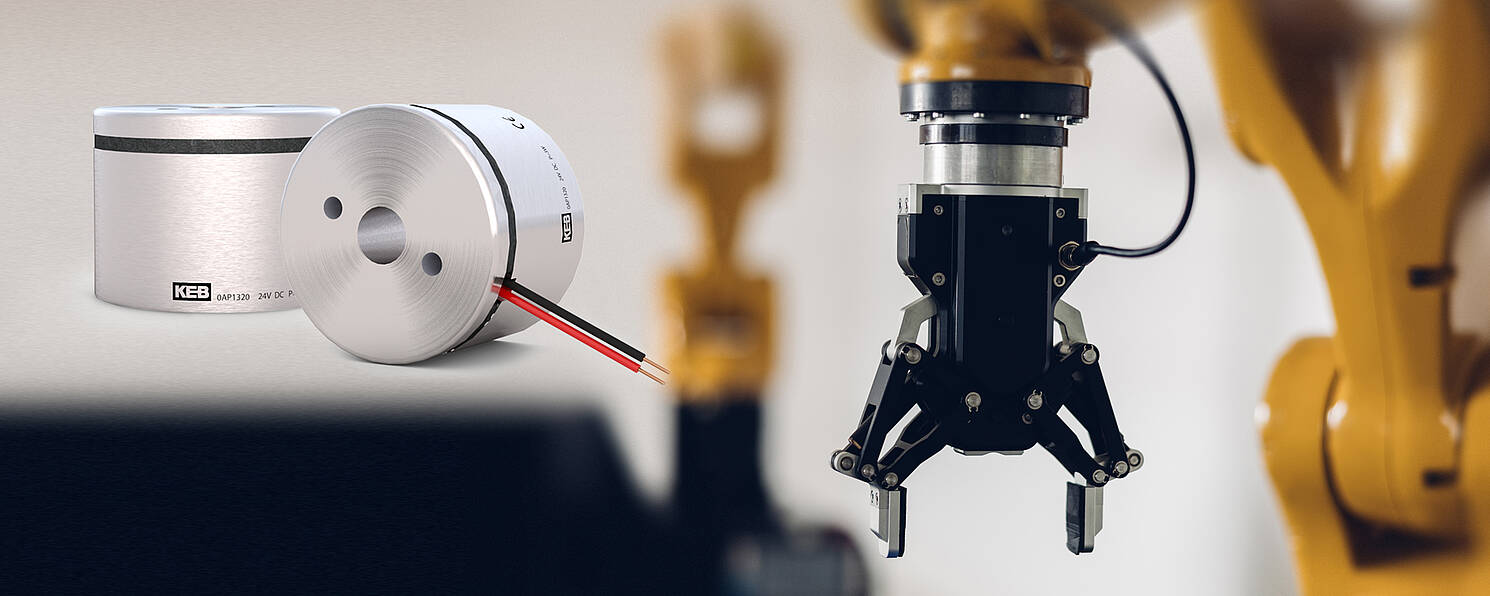
A comparatively small component with a major impact: in many work processes, grippers determine which tasks a robotic system can actually perform. Mounted on the robot’s flange, the gripper combines strength and dexterity. It quickly becomes clear that a robot is only as capable as its gripping system. Reliability, precision and flexibility are the crucial factors that matter here.
Humanoid robots, in particular, place high demands on gripper technologies. As they are designed to operate in an environment intended for humans, their hands must be able to grasp and hold an enormous variety of objects. The challenge here lies in the different shapes and materials, the need for sensitive force control and safe interaction with humans.
Applications of gripping systems
In practice, grippers are used, for example, in industrial automation. In pick-and-place applications, for instance, they remove components from containers, transport them between process steps or load machines and systems. Particularly in mass production, they help to reduce cycle times and ensure consistently high process quality.
In assembly, grippers handle components of varying sizes and properties. They position components precisely for downstream work steps, assist with automatic screw fastening or assemble sub-assemblies. Gripping systems are also indispensable in logistics: in distribution centres and warehouses, robots grip cartons, parcels or individual items and carry out tasks such as order picking, sorting and palletising. With the growth of e-commerce, there is an increasing demand for flexible gripping solutions capable of safely handling a wide variety of products. Furthermore, grippers are used in numerous other sectors, including the food industry, medical technology, electronics manufacturing and automotive production.
Which gripper is the most suitable?
“When we talk about robot grippers, we are usually referring to electric or pneumatic systems. Broadly speaking, pneumatic grippers are characterised by their low weight and ease of operation, though they fall short in terms of precision. This is where electric grippers, which are tailored to the specific application, come into their own,” says Philipp Sölter, Sales Engineer for Brakes and Clutches at KEB, describing the fundamental differences between the two systems. But which gripper comes out on top overall? To answer this, the respective advantages and disadvantages must be considered in more detail.
Pneumatic grippers
Advantages
- Low purchase costs
- Low weight
- Simple operation and integration
- Tried-and-tested solution for many pick-and-place applications
Disadvantages
- Gripping force can only be roughly adjusted via air pressure; fine adjustment is difficult
- Gripping force depends on hose length, hose diameter, ambient temperature and pressure losses
- High running costs due to the generation of compressed air and maintenance of the hoses
- Changes during operation are only possible to a limited extent
- Additional sensors required for position and workpiece detection
- Less suitable for fragile or soft workpieces
- Delay caused by solenoid valves
Electric grippers
Advantages
- Precise adjustment of gripping force
- Gripping force, speed and position can be controlled independently of one another
- Shorter cycle times possible
- Constant gripping force regardless of temperature and cable length
- No reference run required after a power cut
- Suitable for battery-powered systems such as AGVs or mobile robots
- Long service life
Disadvantages
- Heat generation from the motor and brake
- Increased space requirements and complexity
- Heavier than pneumatic solutions
The brake is key
It is not possible to make a general assessment as to whether one gripping system performs better than another. Rather, it depends on the specific requirements of the robotic application. If the task primarily involves simple gripping movements, there is not necessarily a need for an electric gripper. However, where high precision, flexible force control, short cycle times or the handling of sensitive workpieces are required, electric grippers are often a sensible choice. The basis for the safe operation of this end-effector system is provided by safety brakes, which engage in the event of an emergency stop or a power cut and hold the drive in position. “Reliable brakes are absolutely essential, particularly in vertical applications where the workpiece could fall, when handling heavy loads, or in safety-critical processes,” says Sölter. “At KEB, we rely on our small brakes from the COMBIPERM P1 series, amongst others, for precisely these situations.”
The COMBIPERM P1 is a high-performance permanent magnet brake with a friction-based, backlash-free mechanism. When energised, the magnetic field of the permanent magnet is cancelled out and the connected component can rotate without residual torque. “The P1 is suitable for electric grippers, amongst other things, due to its short switching times and compact design,” says Sölter. A total of four brake sizes, starting from 18 mm in diameter, are available. The brake’s design, including the associated user interfaces, can be adapted to the individual requirements of the robot manufacturer – ranging from a bolt-on flange and torque adjustments to hub mountings with pre-assembled connectors.
