Good motor efficiency is not the only thing that matters
KEB focuses on system solutions rather than individual components
When selecting (geared) motors, plant and machine manufacturers need to consider many different product characteristics. Almost always, the focus is on efficiency – and there is good reason for this. However, other factors should also be taken into account to ensure that an application is driven efficiently. The goal: to move away from considering a single motor and towards an approach in which the motor is part of an overall system.
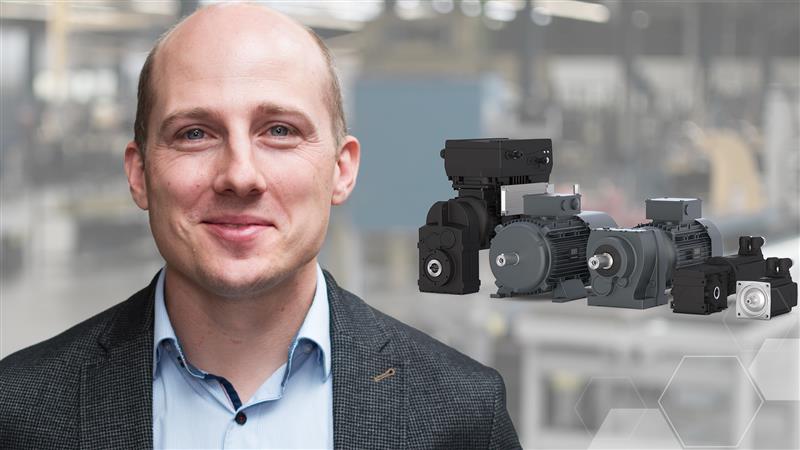
Helical gear, shaft mounted and bevel gear units from KEB have one thing in common: they all offer high efficiency. Levels of 94 to 96 percent are achievable, providing the best conditions for particularly efficient operation. The efficiency of electric motors must also be taken into account: permanent magnet synchronous motors and synchronous reluctance motors offer comparably high efficiencies that exceed the efficiency of an asynchronous motor.
It is not without reason that the efficiency of electric motors is an exciting key figure, as it indicates how efficiently electrical energy is converted into mechanical work. High efficiency means that a motor generates less power loss in the form of heat and therefore operates more economically, durably and sustainably. According to the IEC 60034-30-1 standard, mains-powered three-phase motors are divided into efficiency classes such as IE1 to IE4, with higher classes indicating better efficiency.
Good to know
IE1 = Standard Efficiency
IE2 = High Efficiency
IE3 = Premium Efficiency
IE4 = Super Premium Efficiency
In mechanical engineering, efficiency not only influences energy costs, but also the design of entire systems. An efficient motor reduces cooling requirements, enables more compact designs and lowers the overall energy consumption of industrial processes. Since electric motors are among the largest consumers of electricity in industry, high efficiency leads to significant savings and improves the environmental balance. Efficiency is therefore an important criterion in the selection, dimensioning and evaluation of drives in machines and production plants – but it is only one of several criteria.
What about insulation?
A factor that should not be underestimated when selecting motors is thermal load capacity. This often has a greater influence on the operating limits of motors than the purely electrical design. “Losses are converted into heat, which can result in a motor that is still electrically powerful but has long since been thermally overloaded. The problem is that overheating can lead to rapid ageing, short circuits between the windings or even total motor failure,” says Daniel Lehmann, Head of Sales and Marketing at KEB Antriebstechnik.
On the one hand, it is therefore important to ensure adequate cooling. Against this background, KEB's DM or DA asynchronous motors are available with optional internal or external fans. But the winding insulation, one of the most sensitive parts of the motor, is also of central importance. This specifies the maximum temperature that the winding can withstand continuously. “With the AL4 series servo motors, for example, KEB has a motor with winding insulation H in its portfolio – the highest of all common classes, which is designed for a continuous temperature of 180 degrees Celsius,” says Lehmann. The design of a motor according to insulation class and the design according to efficiency are two different approaches that need to be balanced.
Interaction with drives and co.
As a system provider, KEB focuses on the optimal coordination of different components. The COMBIVERT F6 drive controllers or S6 servo drives from KEB ensure that the speed of the motor can be flexibly adapted to the process thanks to the variable output frequency. In addition, a smooth start-up and run-down reduces mechanical stress and avoids high starting currents. The inverter adjusts the voltage and current to the load, stabilises the torque and prevents overload situations. This significantly reduces energy consumption, especially in applications with different speeds. In addition, the drives perform protective functions, such as monitoring the temperature and motor status. Operating the motor with COMBIVERT frequency inverters creates the conditions for precise positioning, synchronisation and comprehensive diagnostic options. This turns a simple motor into a powerful, safe and optimally controllable drive.
Integration into existing systems
KEB drive components are designed for seamless integration into existing control and motor systems with or without encoder feedback thanks to adaptable fieldbus and encoder interfaces. KEB motors are also compatible, avoiding costly modifications and simplifying installation. “Our motors and gear motors are available in various sizes and with a wide range of flange dimensions and shaft sizes. This enables us to find the right gear motor solution for almost any existing application,” says Lehmann.
With the KEB-DRIVE software, KEB offers a tool that users can use to search for gearboxes and motors and configure them individually. Once the user has identified the relevant requirements, these can then be entered into KEB-DRIVE. If, for example, a PTC thermistor is required for the application, this can also be selected in the tool. With little effort, the optimally matched gearboxes and motors from KEB are displayed after a short time. Lehmann: “In no time at all, the motor solution that fits the customer's system is found. This reduces installation costs and saves money.”
Daniel Lehmann
Head of Sales and Marketing at KEB Antriebstechnik
+49 3772 67-217
+49 152 09331487
daniel.lehmann@keb-drive.de